
Talent Blurs at the Gateway
The City, the TBA, and an Incubator Proposal collapse into a pile of WTF at Talent's most exposed corner
I’ve been writing this extra long post in angst-filled spurts for almost 4 months now, as some of my once-patient friends and readers have started to remind me. I’ve revised it repeatedly as new developments kept shifting the ground beneath it. More than once, a near-final draft was upended by information that forced an argument to be rethought or abandoned altogether. That instability feels almost poetic, a reflection of the story itself. A process defined by moving narratives and a political environment that makes it difficult to know if or when the full picture has been revealed.
What we’re experiencing in Talent is a distortion of public decision-making, one that can occur in small towns like this when the people responsible for making neutral public decisions are also responsible for advancing the interests of private organizations. Because the Mayor of Talent leads both the City and a nonprofit that depends on City contracts, outcomes can not be treated as neutral, even when every technical requirement is met. That’s what this post is mostly about, and the proposed Gateway Hub is the case I use to make the point.
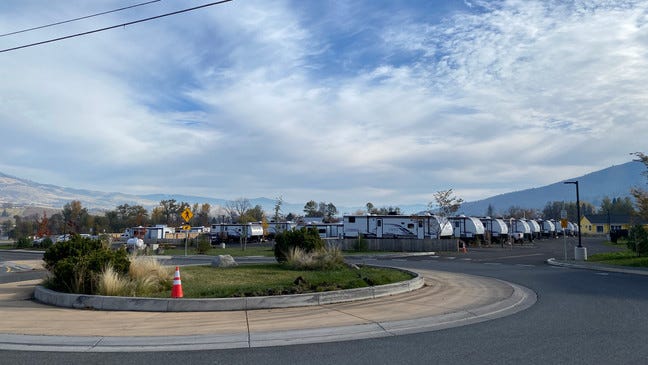
The Gateway has a long and tangled history in Talent marked by delays, false starts, overflowing RVs, and controversies stretching back years. But this is not a litigation of that history, nor is it a comprehensive accounting of business incubator concept. You don’t need encyclopedic knowledge of the Gateway to see the ongoing pattern of concentrated power shaping our civic processes based on insider priorities instead of the voices of regular people. And you don’t need to understand much about it at all to know there’s something not quite right about City Council directing substantial public resources to its Mayor’s nonprofit. What I find most deserving of watchdog-style scrutiny is not the Gateway Hub itself, but what the process of moving it forward is telling us about our city’s institutions.
This piece does not contain any allegation of criminal wrongdoing. It’s an examination of power and process interacting under an unusually influential and over-affiliated Mayor to produce the kind of forgone outcomes we’ve come to expect in Talent; the kind that feel like they were manifested into being long before anyone is ever invited to an Open House.
The issue we face in Talent is not whether the City follows the rules to the letter of the law, but whether the public can trust that decisions are made for the public’s benefit rather than to favor insiders. At this point, using the Gateway as a case study, I argue that we cannot.
Before we dig in:
I’m using “I” now in my own writing instead of “we” because it’s time to open up authorship of TCW Reports to other Council Watchers and people in the community who have something interesting to say about Talent government. That means I have to pick a pen name for myself, because despite calls by local conspiracy theorists on Facebook for TCW to reveal identities, I’m not actually interested in blowing up my life and will be doing no such thing you absolute nutters. But we do need to differentiate between authors, so for that reason I will now be known here by a name of several lifetimes ago: Buddy. So in the future when you see Buddy in the byline you’ll know it’s me, the original TCW author. And if you would like to contribute to all the watchdogging we’ll be doing here, please send an email to talencouncilwatch@gmail.com
The Gasp-Inducing Vote at the Very Special Meeting
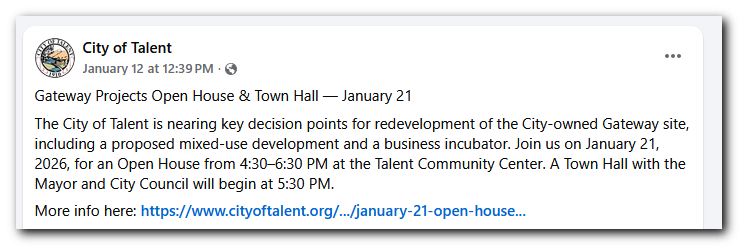
The City of Talent invites community members to attend an Open House to learn more about the Gateway projects, including the proposed business incubator and larger site redevelopment. This is a great opportunity to hear about the vision for the Gateway site, ask questions, and provide input on these important development efforts.
When: January 21, 2026
Time: 4:00PM - 5:30PM
Where: Talent City Hall, 110 E Main St, Talent, OR 97540Handouts and related documents and reports can be found here
Well good for them. Great idea. Hope they get a huge turnout. Hope it genuinely helps them decide which Developer to go with. Should have happened before almost 1.75 million dollars was sent TBA’s way.
We’ll get back to this Open House at the end of the article. For now let’s go back to the reason this is taking place, which is the November 5th, 2025 Very Special Meeting of Talent Urban Renewal Agency (TURA). This was called for the purpose of voting on whether to spend the last $500,000 of the City’s urban renewal funds to build a “business incubator” on the very visible corner of Valley View and Hwy 99, a piece of land fittingly called the Gateway.
Watch the whole meeting on YouTube here.
If you haven’t read much about the Gateway project yet, you should start with a TCW Report from back in June 2025. It will give you some context that is missing from this article.
The Very Special Meeting was also to vote on exactly who would constitute the Advisory group that would recommend a developer to build the Gateway out with infrastructure and residential and commercial structures. (SPOILER: Three TURA members, including the Mayor/Director of TBA, decided not to allow non-Council members on to the Advisory group and ultimately picked themselves to be responsible for recommending a Gateway property developer… to themselves).
At that meeting a solo brave member of the TURA/Council, first-year councilor Rosario Medina, dissented from the majority opinion, breaking a long-held record of every Talent government body voting to give the Mayor’s nonprofit whatever it asks for.
That’s right, a Talent City Council member attempting to represent the voices of their constituents, and backing it up with an actual dissenting vote! Once in a while we’ll hear one of them give a halfhearted nod to some percolating public sentiment, but rarely does it ever result in a dissenting vote. Usually it’s a token, un-actionable acknowledgment and weak call to keep something in mind as they vote with the majority. Medina’s gasp-inducing “No” was enough to make this meeting a Very Special one indeed.
The issue she brought up was whether the process leading to this major financial decision had sufficiently sought and considered public input, or whether more feedback was warranted. Medina, having actually listened to the concerns of many of her constituents, asked if there was a reason why the decision couldn’t be postponed until more input was collected, via a Listening Session or something similar, so that the Board could find out what the current concerns of the community are before making a big financial decision instead of after. The idea was swiftly shot down by the rest of the group.
17:43 MEDINA: I’m kind of concerned because I’m hearing from the community that they don’t feel like we’re being transparent enough, and having a listening session could, and that I would at minimum like to have some sort of plan to hear from the community. It sounds like there’s been opportunities. But also it sounds like people in our community do not understand that was the opportunity to speak out about it.
Why can’t we wait till we get all the information back? If they’re willing to push it to February 29th, or if we can at least have a listening session, so we can at least make sure people aren’t saying this is like something nefarious or anything like that, right? We’re transparent, we’re clear, this is what it is, period.
22:08 MEDINA: So hearing, hearing a lot of everything going on, I’m still concerned about people saying they have not had input and not just the people we’ve heard from today [referring to 2 letters submitted to this meeting]. I’ve heard of a couple organizations too. I would feel more comfortable if we could even just offer a listening session, just offer it before we make a decision. It’s how I personally feel. I just want to put it out there. It’s not a question, I just want to put it out there. I ran on transparency and that’s very important.
The justifications then offered by members in this meeting for keeping the public out of this $500k decision were mostly about how heavily involved the public has been up until now and will get to be in the future, and that Council already knows how much we all want and need an incubator.
Member Daniel Collay worried about what the public would want to add their input about.
22:53 COLLAY: My question with that listening session would be what are people weighing in on? And are we, you know, re-talking about the multiple public information sessions and studies that we've done about Gateway as a whole? Are we just specifically talking about the TURA part of the allocation for the business incubator? Are we also talking about the PIER part of it? I'm all for hearing both from people and I just fear for leaving it open-ended and, you know, reopening the whole thing when we're basically like going down the road on the Gateway project as a whole.
Member Ponomareff explained that the City has involved the public so much already and what they were told by the public - what the public is “begging for” she said - is an incubator, which she thinks those who had been paying attention would know already.
24:36 PONOMAREFF: I think that anybody new coming in who hasn’t, you know, been, I don’t want to say paying attention, but hasn’t been involved in these events, public facing events, might think that we haven’t been transparent about this. But I think we have been transparent. We have done tons of outreach. I remember a particular one where we played with Legos on table tops, and that was really fun. But I don’t want to, uh, it feels like we’re at a point right now where we’re trying to tell OHCS we are serious about some doing some meaningful commercial things that our community has been begging for for years, and business incubation has been a desire of Talent documented for many years. Now, the Feasibility [study] may speak to what kind of business incubation would be best, and that’s fine. But we’re not there yet. I feel like right now we’re here to say yes, we are serious. This is a good use of our money. And here’s what we’re going to, we’re going to contribute to that. To the point about, uh, I’m getting the public more involved. I think yeah, we should. I think we should let them know here are our plans and get some input along the way, but I don’t think there’s any reason to stop the progress that we would have made a couple of weeks ago if we had had quorum, but we didn’t.
Mayor Ayers-Flood presented a People’s History of the Gateway Incubator, telling us about the tremendous amount of public input that has shaped the vision she hopes will soon be implemented. She cited 4 reports that, all based on extensive public input, she claimed, recommended Talent build this incubator. These reports, she said, are “recognizing that business incubation is a powerful tool” and that an incubator in Talent is “called for often, it’s called for before and after the fire, and it’s called for very specifically.”
Note: Her claims could not be verified as those cited reports were not made available to the public at that time nor for 2+ months after this meeting.
The Mayor explained that there will be plenty of opportunities for public input later, i.e. after this vote that allocates $500,000 of that public’s money to building her incubator is already in the bag thank you very much.
Member Byers managed to squeeze an actual truth nugget in there before the buzzer:
38:07 BYERS: It is such an unfortunate situation that we as the larger Southern Oregon community are in, but there’s limited news coverage of anything. And folks are having to be their own journalists. {TCW waves back. Hey girl!}
And I think we, as a City, especially with something that’s a big decision and has one that has quite a complex back story, I think that the onus is on us to provide our residents with some additional tools to be able to do some information sifting for themselves.
This is of course true, but it's also one of those un-actionable nods I was referring to earlier. Byers is especially adept at the nod.
So the motion passed and $500k will indeed be directed toward building a business incubator on the Gateway property, but a stand has been taken. Medina objected with her vote, and that changed the way the City subsequently dealt with the question of further public input on this project. It’s something.
Is it too little too late? Yes. For sure. Are the City’s efforts a little weak and performative? Perhaps. Will this Open House change the City’s or TBA’s plans in any meaningful way? Highly doubtful. Welcome to what we’ll be discussing today.

The Narrative Misdirection
Prior to scheduling the Gateway Open House, City staff followed the Nov 5, 2025 meeting up with publishing a timeline in Talent News & Review without any context and probably confusing the hell out of people who haven’t been keeping up with the meetings.
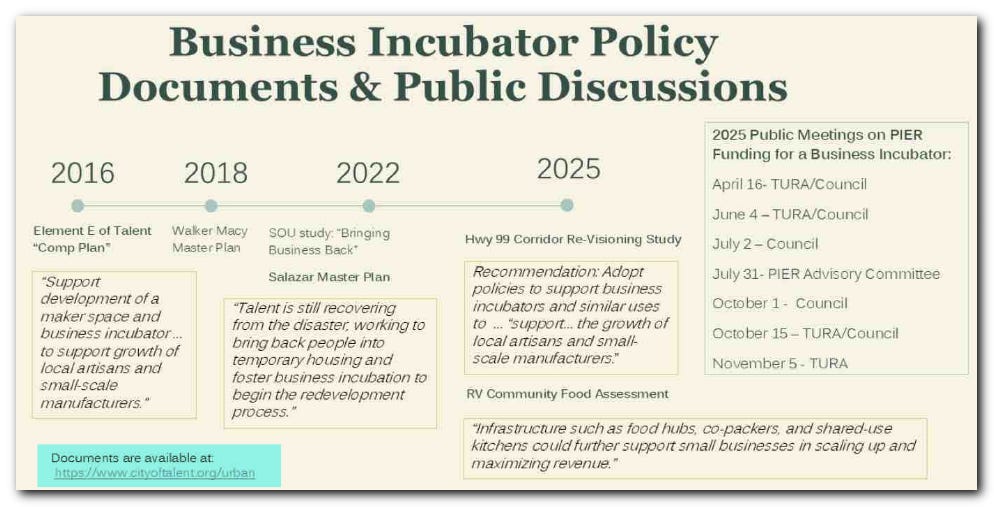
Note: Zero of the documents referenced in the timeline are actually available at cityoftalent.org/urban as stated. Nor do most of the links work on this page. But for however long this page stays up you can download several of the reports.
The purpose of publishing this standalone timeline was not to engage with public concerns, but to tell residents we are mistaken and that our concerns don’t need to be addressed. “Look at all the meetings we held where you could have said something. Look at these isolated quotes from old reports that use the word “incubator.” See? We’ve already done more than enough.” That’s the unmistakable message being conveyed.
This comes off as not only dismissive and arrogant but also as a distraction from the far more serious issues at the center of this project. Even if the City could credibly argue that it has met the bare minimum requirements for legal transparency, that completely sidesteps the issues that actually matter to most of us out here, the biggest of which is the inherent conflicts created by Talent Business Alliance’s involvement in City government at every stage of this process.
Were meetings held? Do reports exist? Those are procedural questions with defensible answers. They are not the substance of the public’s concern. This is all misdirection.
Here are some real questions: Who will stand to personally benefit from the City’s plans to develop the Gateway? What decisions about this project have been genuinely shaped by public input and what was decided on behind closed doors? Who exactly is making these decisions? Is TBA’s continuing involvement in decision-making about the Gateway ethical and appropriate, considering all the overlap?
When they narrow “transparency” down to a checklist of meetings and documents, they’re trying to create an appearance of accountability without engaging the significant ethical concerns raised by TBA’s direct participation in City decisions.
And also? Citing six and eight-year-old report language casually referencing incubators does not remotely establish what Talent residents feel like Talent needs in 2026. Things have changed. A lot. They know this.
The January 21st Gateway Open House is being held after the big decisions have already been made. Again, yay for them for setting it up in response to the backlash and inviting people to say their piece, but given the timing and Council meeting discourse around public involvement, it seems very unlikely to change much about the direction this project is headed, which is the Mayor running her own publicly-funded multi-million dollar incubator and revenue-generating food business compound.
Let’s go back to the November 5th meeting for one more nug. Medina ended her contribution with this statement right before the gasp-inducing vote:
36:43 I think anything that can help businesses and our residents of Talent to create a business, especially because it’s really hard to start one up, is great. I just really wish we had time to address some concerns and to clear up doubts about this, like how it’s coming about and TBA involvement or not involvement.
In the meeting in which she dropped that little grenade, no one dared pick it up for discussion. TCW is picking it up right now. Let’s go.
Hey That Deck is Stacked!
A few months ago, a local resident publicly challenged the Mayor on the ethics of the role overlap between TBA and the City.
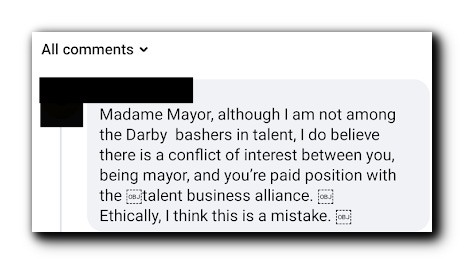
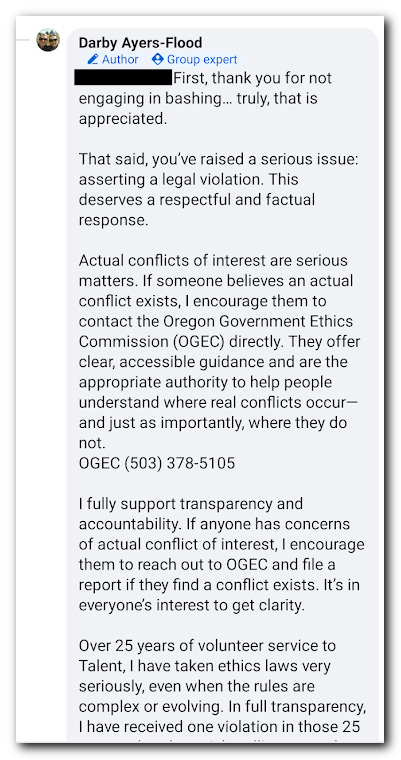
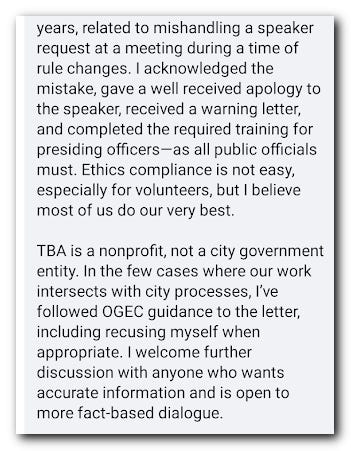
The Mayor did not treat this as an opportunity to meaningfully address concerns. Instead she denied any criminal wrongdoing and invited critics to contact the Oregon Government Ethics Commission if they thought they could prove a violation.
Her response is instructive. It reflects a mindset that runs through much of Talent City Council and shows up repeatedly in their comments and decisions. Ethical concerns like this are treated as relevant only if a single, discrete act can be proven to be a violation and subject to punishment by OGEC. If not, the complaint is dismissed a personal attack, partisan sabotage, bad faith, or ignorance.
The Mayor’s “fact-based” framing in that comment makes it sound like the facts only matter if they are looked at one at a time. It doesn’t leave room for situations where individual facts may appear mostly benign but collectively describe something deeply concerning to a lot of people. Misused power doesn’t often reveal itself through only a single illegal act. It shows up through patterns, accumulation, consistency.
What do we call it when no one fact is disqualifying on its own, but a hundred of them align in the same direction? When political access and successful outcomes repeatedly converge around the same person, the same organization? Those teamed-up facts start telling a story about how the system actually works that isn’t quite so benign.
From even before day one, TBA has had the inside track on the Gateway. At every stage of the proposed project, TBA has been given everything it needed from the City - including unfettered access to information and a whole lot of money - to turn the incubator hub from a lofty vision into an earth-toned building.
Of course it makes a lot of sense that with the TBA Director sitting at the head of every single table, public or private, the process would favor TBA. Still, it’s remarkable how whenever a decision is placed in the hands of Talent City Council or its TURA doppelganger, it consistently tilts TBA’s way.
I say that’s not a coincidence. Or luck. Or good proposal writing. I think it’s what happens when the person presiding over the City is also running the nonprofit that needs the City’s business.
To understand how our decision-making structure became so distorted, it feels necessary to look at the scope of authority vested in the Mayor and how that authority operates in Talent. We have a model in Talent that makes informal influence and agenda control particularly powerful, and that makes us relatively powerless to stop it.
It’s worth mentioning that the Mayor’s formal powers are relatively limited under the City Charter. Talent operates under a weak mayor–strong council model where the role of Mayor is intended to be largely ceremonial and duties are mostly around facilitating meetings, breaking tie votes, and serving as the City’s spokesperson. In practice, this particular Mayor has expanded the role’s influence well beyond those bounds.
Taken together, the following conditions describe the decision-making environment in Talent and help explain how TBA has acquired persistent and substantial insider advantage that it has today.
How the Deck is Stacked:
The Mayor serves as Chair of both City Council and TURA, presiding over meetings, controlling the flow of discussion, and casting tie- breaking votes. Every major decision affecting Talent is made in her presence and under her authority. As presiding officer, she frames how issues are described, which questions are treated as reasonable, and which concerns are dismissed as distractions. The Mayor dominates deliberations by proposing ideas, framing issues, and steering discussion. Her perspective is present in every stage of City decision-making, even when she does not formally vote.
The Mayor presides over executive sessions, including closed door discussions about staffing, hiring, personnel matters, and legal strategy. Even conversations shielded from public view take place under her direction.
The Mayor appoints all members of City Commissions and Committees and conducts the initial interviews. As a result, almost every group that delivers recommendations or reports for Council is composed entirely of individuals she has selected. She also presides over meetings in which Advisory Board members are selected if they are not appointed by her directly. Sometimes she appoints herself.
The Mayor is involved at the earliest stages of idea formation, long before projects are formalized. This allows her nonprofit affiliation to align itself with and even suggest emerging priorities before alternatives even exist.
The Mayor helps shape the scope and language of RFPs/RFIs to determine how City funds are spent and which organizations are even eligible to compete for City contracts.
The Mayor has access to all RFP/RFI submissions received by the City as they come in, including letters and applications submitted by her own nonprofit’s competitors.
The Mayor has immediate access to every report, study, and analysis commissioned by the City. She can obtain information as needed by directing City staff to get it for her.
The Mayor meets personally with consultants, community leaders, grant administrators, and authors of reports and studies, often in informal settings, positioning herself as the City’s representative while also leading a potential beneficiary organization.
The Mayor routinely signals in meetings how she would vote in the event of a tie, telegraphing her preferred outcome in advance. This shifts her power from merely breaking ties to openly influencing how others vote.
The Mayor has the authority to decide whether or not to recuse herself from the discussion, abstain from voting, or remove herself from the dais in matters where there may be conflicts of interest. Recusal/removal is voluntary and operates on more of an honor system than an enforceable standard.
As you can see, that’s more than a few isolated privileges. We’re talking about an entire system of overlapping authority, information access, agenda control, and personal influence that consistently advantages one organization over all others.
Fun thought experiment!
Replace the word “Mayor” in each of the above with “TBA Director” Because that’s exactly the situation Talent is in right now.
Seriously, does that sound like a legitimate structure from which to make major decisions with far-reaching consequences for the City, the TBA, and all the people who live here?
The line between a public entity and a nonprofit matters because it defines who is actually accountable to the public, who controls the money, and whose interests are prioritized. But what we have in Talent is a system that completely depends on the personal integrity of one individual, rather than on a structural separation of powers, in order to maintain that line.
Collectively, we have way too much riding on that one person being able to keep their roles from blurring into one another. It is simply not a trustworthy system.
Take the Gateway, For Example
The Gateway process shows what those 10 deck-stacking conditions look like when real decisions are being made. What follows is far from an exhaustive accounting of every instance where overlapping authority mattered, it’s a focused case study of how the Mayor’s dual role influenced key moments in the Gateway project. These examples are meant to illuminate the broader structural dynamics discussed in the above section, not catalogue them in full.
To bring the timeline current, the Request for Information (RFI) for the Lead Operator of the Gateway Incubator closed on January 20, 2026. Only two letters of interest were submitted: one from the TBA, and one from a Texas based firm proposing a technology incubator. The other firm was not invited to submit a full proposal, apparently ending its participation in the process. As far as I can tell based on publicly available information, TBA is the only organization expected to submit a full proposal to the City by the February 7th 2026 deadline.
To understand how the Gateway Hub became the chosen project, it helps to look at where the idea originated and how it evolved. This is a story about how a rejected proposal was repositioned as a public necessity, and the friends it met along the way.
TBA Somehow Makes Gateway Hub Inevitable
TBA Board Treasurer Awna Zegzdryn first presented the Gateway Hub to a joint Council/TURA on April 16th, 2025. But a very similar project had originally been introduced in an earlier phase of PIER (Planning, Infrastructure and Economic Revitalization) grant funding process when, in 2023, Zegzdryn and Mayor Ayers-Flood applied for $7.27 million to buy land on Hwy 99 and build a food-centric business incubator called Rogue Food Hub. Their request constituted more than half of the total allotment of 13.85 million designated for fire recovery aid in all of Jackson County. This was in addition to the Talent Business Alliance also applying for 3.45 million for business support, 60% of which would have been for overhead/salaries.
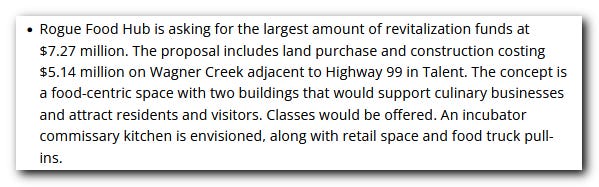
At the close of that phase of grant selection in Winter 2023/24, neither the Rogue Food Hub nor TBA was chosen to receive PIER funding. Or rather, not in any straightforward kind of way.
The City of Talent, however, was awarded 4.6 million of that PIER money to develop the Gateway property. This was called the West Valley View Plan Upgrade & Revitalization and here is an outline of that plan.
At this point TBA board members and Rogue Food Hub would-be founders, Zegzdryn and Ayers-Flood, switched up their strategy. Instead of trying to pitch their commercial kitchen hub to another funder, they lightly reheated the concept, renamed it, and absorbed it into the TBA. They then presented it to Council/TURA as the solution to problems most of us in Talent didn’t even know we had!
The goal of their April 16th, 2025 presentation seems to have been to get a cut of that PIER grant money by explaining to Council/TURA members that the City’s commercial development of the Gateway site - if that included the TBA’s Hub - would satisfy the public benefit requirements of the grant it had just received.
(A public benefit is basically the community’s return on investment when public funds such as the PIER grant subsidize what is otherwise a private development. It ensures that public money creates real value for residents, not just opportunities for developer profit).
But the pitch to Council/TURA went beyond simply meeting a requirement. The structure TBA was encouraging them to adopt would let the City, even at that early stage, frame Talent’s need in a way that guaranteed TBA’s incubator would appear to be the perfect and perhaps only solution. The message was: It’s not just any community-serving public benefit feature, it’s a food-centric business incubator! Exactly what the people of Talent have been begging for all these years!
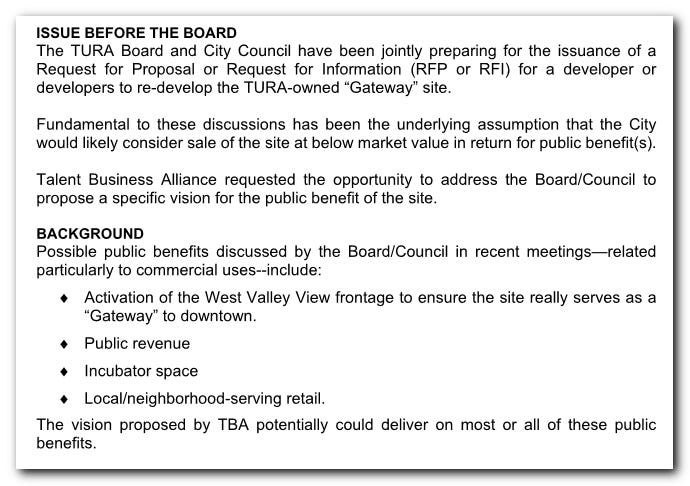
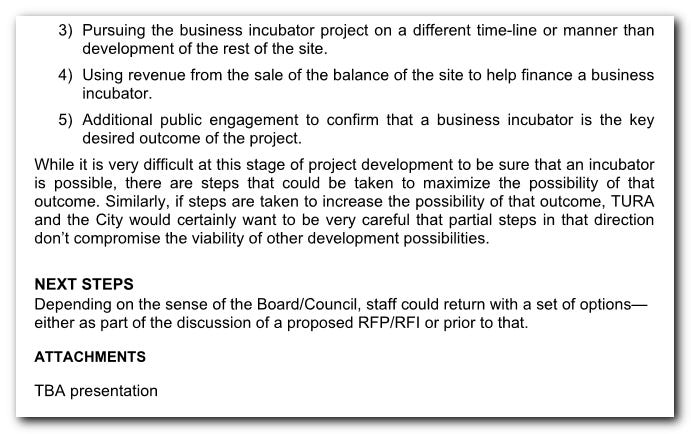
“While it is very difficult at this stage of project development to be sure that an incubator is possible, there are steps that could be taken to maximize the possibility of that outcome.”
- Alex Campbell, April 16 Study Session Staff Report
TBA caught a lucky break in June when the Wagner St. extension piece of the project fell through - details on all that here - and the City suddenly had $1.25 million to spend on something else for the Gateway. Naturally TBA, with a big assist from Campbell, jumped on that opportunity, easily convincing TURA to rehome all that liberated money over to building TBA’s hub.
The City wouldn’t even have to bother with manipulating the developer procurement process to ensure an incubator would be built like they had discussed, it could just reroute its own grant money to build the thing directly.
Campbell had to run this past PIER Advisory though, since a business incubator was not what the grant was supposed to fund, and the same group had in fact rejected the Rogue Food Hub proposal when it was presented by the same people the previous year, without the City backing it.
On July 2, 2025 Campbell sent a letter to PIER to start the process of requesting changes, then presented his proposal to the PIER Committee on July 31, 2025. The Proposed Activity he presented in that meeting was word-for-word TBA’s proposal for their Gateway Hub food-centric business incubator. The materials he presented included TBA’s claim that the need for a business incubator in Talent was identified through its own “ongoing community engagement, surveys, and public presentations.”
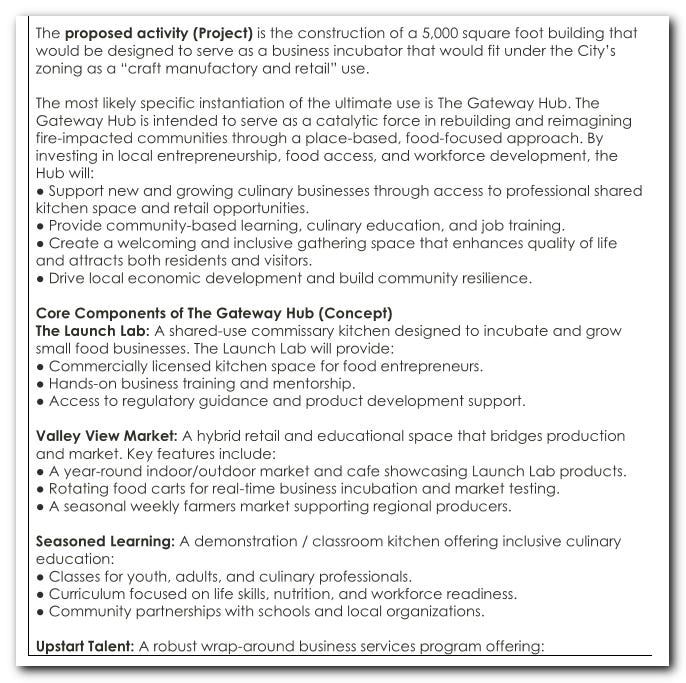
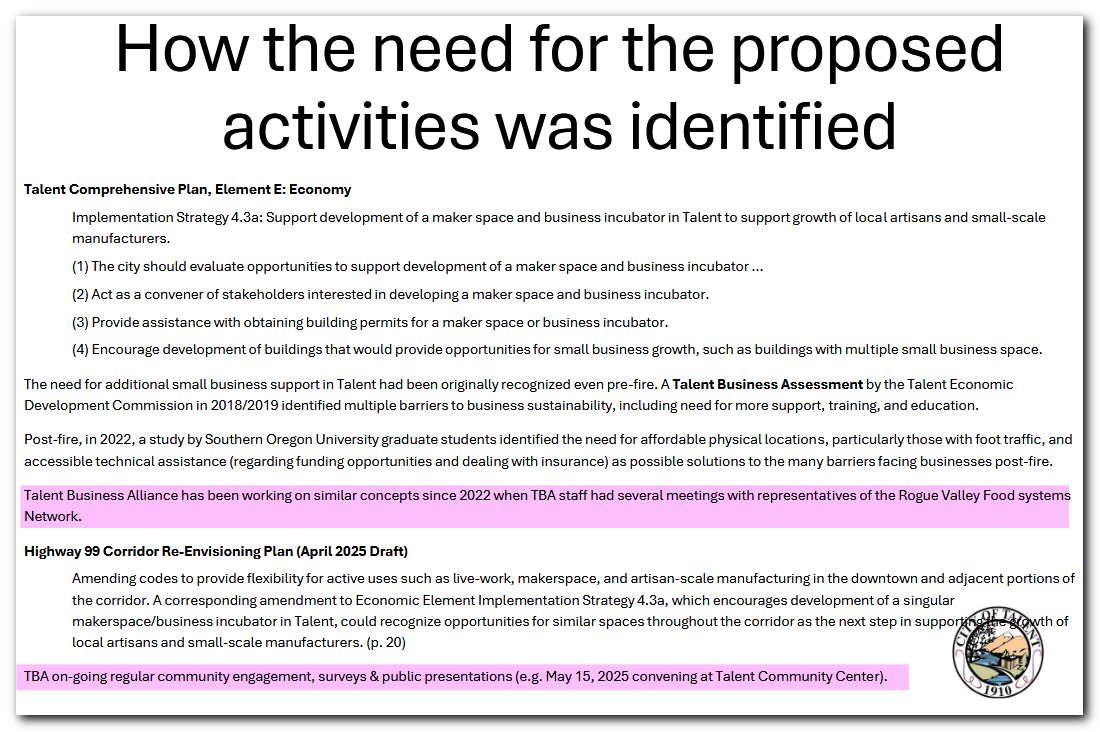
To summarize: City Manager Campbell convinced Council/TURA that re-routing 1.25 million from the road extension to TBA’s Hub was a solid plan and would help TBA be able to get enough funding for its full construction, then he went to PIER for approval to do that. He used TBA’s presentation content as the concept that would be implemented and he cited unspecified work that TBA claimed was how they know that a food business incubator is what the people want.
They were sold. PIER recommended the funding redirect and once its parent agency OHCS had a chance to review and discuss, it decided that the City of Talent needed to further secure its commitment to the Gateway Hub project. But the City’s allocation of $375k plus more later - when the property sells - was an insufficient commitment. Campbell then proposed to TURA in a subsequent meeting that they push all of their remaining $500,000 into the Gateway Hub construction in order to prove to PIER that the City is serious about this thing. This action is what would make PIER funds fully available for building the entire Gateway Hub.
The resulting meeting and gasp vote on November 5th is what started this article off. TURA voted to fund a portion of Gateway Hub construction with its remaining savings in that meeting. The meeting where no one recused themselves despite 3 of them being paid by the beneficiary of the decision, and then they voted to give the the last of TURA’s money to start building the Hub that TBA wanted to build.
It’s important to remember that the Mayor didn’t have to vote one single time in that entire sequence for all of it to tilt in TBA’s favor. Recusals would likely not have even affected the outcome, not with the dynamics we’ve got going on here!
We can even connect this early stage involvement from TBA right back to the present - the other application for the Lead Operator (TBA’s supposed competition in the selection process). Here is the City Manager’s Agenda Report for the January 7th 2026 City Council meeting.
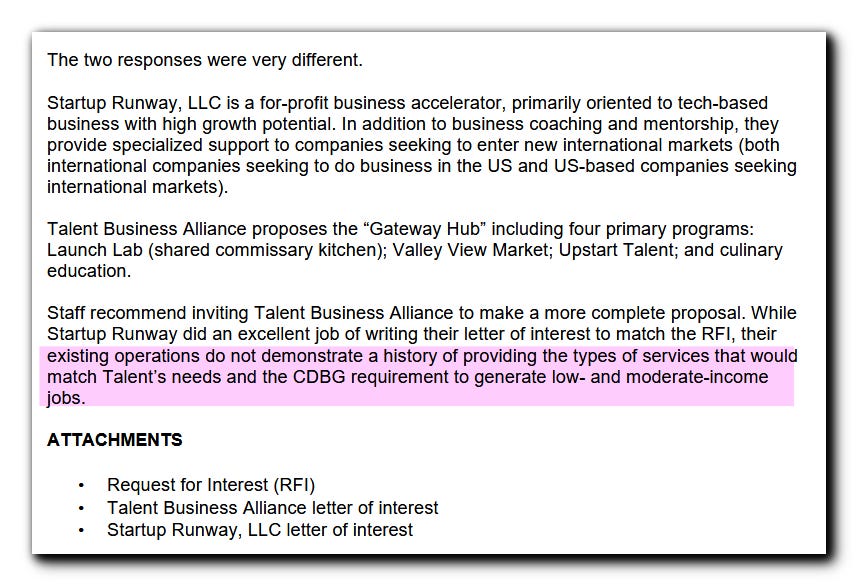
“Their existing operations do not demonstrate a history of providing the types of services that would match Talent’s needs and the CDBG requirement to generate low and moderate income jobs”
Remember, “match Talent’s needs”as they were defined by TBA when they presented their proposal for an incubator!
And that is how this kind of insider access actually plays out. Not a “fact-based” OGEC fine, but a hundred seemingly inconsequential statements in Staff Reports just like this, which, when all put together, point to one enormous elephant in the room that no one wants to admit to being able to see.
What if all the reports and the surveys about business and entrepreneurship that mentioned “tech” in Talent were highlighted in the City’s reports and timelines instead of “food,” and that was used to argue for the development of a technology hub? What if this other company had the City give them money to conduct a study on if their tech incubator model would work in Talent?
The profoundly influential relationship between the City and TBA matters. A lot. It’s not something that can be dismissively waved away any longer.
The $30,000 Feasibility Study
In July 2025, TBA was given $10k of City money to work with a firm called Marketek to produce a Gateway Hub Market Feasibility Study. This would “flesh out the operations finances of the Gateway Hub.” The other $20k portion of the fee was funded by a grant to TBA from the Ford Foundation.
(The purpose of a feasibility study in this scenario is to provide legitimacy to a plan, show that the project is in fact viable and won’t be a waste of money, and demonstrate that it is supported in the community, among other things)
The project that Marketek determined the feasibility of was a food-centric hub and incubator. Not just any business incubator, but specifically TBA’s vision for the food business incubator hub that it wants to build at the Gateway site.
TBA was Marketek’s client, not the City of Talent. The study was designed entirely around TBA’s model and resources. In fact, one of Marketek’s stated values for the study was a “commitment to build TBA’s capacity to succeed while scaling project work to your capabilities”
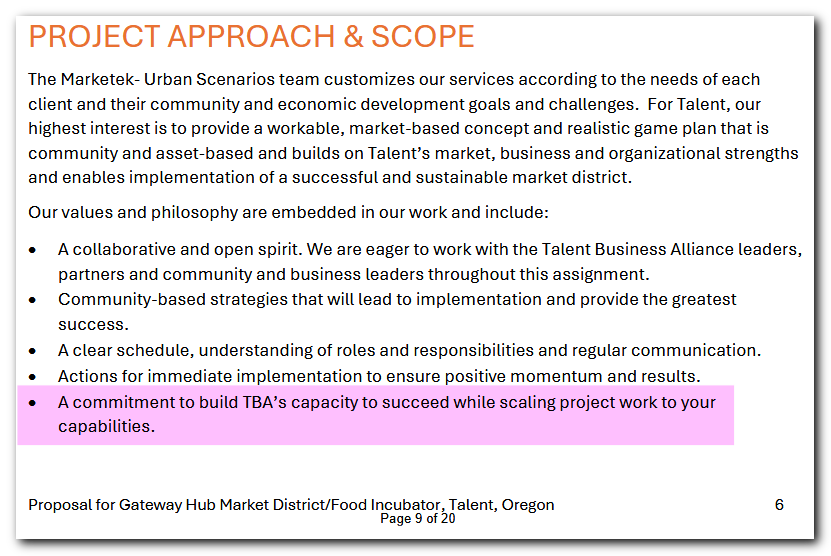
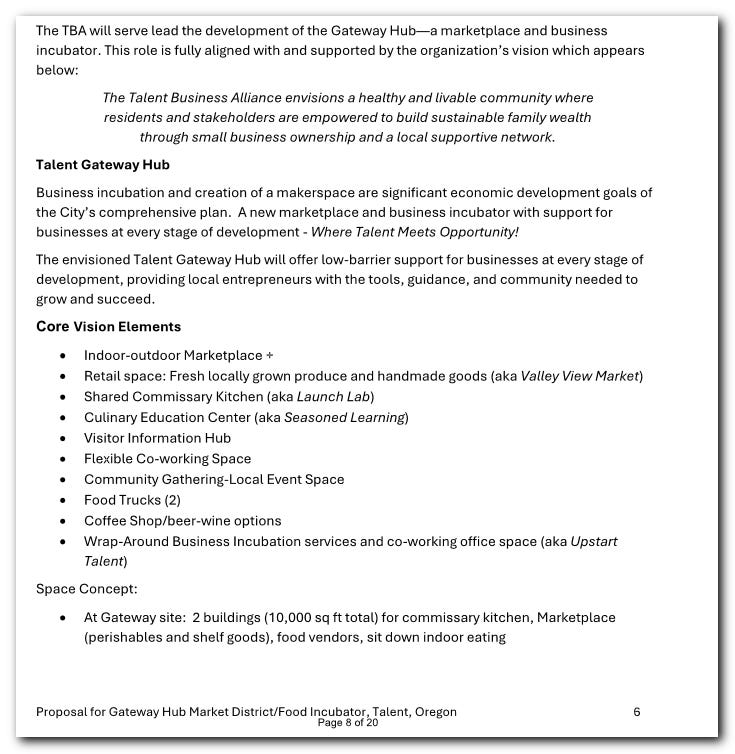
So then, TBA got a free-and-clear $30k, 10k of it from us, to spend on a study that will instruct them on how to successfully implement the incubator project they’ve been trying to get going for years now.
Imagine if the other applicant for the Lead Operator role had gotten a grant from the City to conduct a study on how they could make their exact tech incubator vision work for Talent - before they even officially applied for the job. That’s the kind of competitive advantage we’re taking about, times 100.
FYI, this is how the City is describing that study in their hand out packet for the Open House on Wednesday:
TURA and the Ford Family Foundation have funded a study that will be available soon to help answer the feasibility question by looking at the local market for business incubator services and developing a model operational budget for the incubator.
Seems like it’s missing a few relevant facts.
The Wacky World of Predetermined Procurement
With the deck stacked the way it is, contractor procurement often doesn’t function as a tool for selection. It’s more as a tool for protection. The City’s approach to selecting a Gateway Hub Lead Operator shows how processes are used not to discover the best option to perform work, but to manage scrutiny given the outcome is already assumed.
After his presentation to the PIER group asking to re-route the Wagner Cr. extension money to build the incubator Hub, OHCS asked Alex Campbell about the City’s Lead Operator selection process. Since there wasn’t one, because they were always just gonna give it to TBA, Campbell’s response in his 10/1/25 Staff Report was to ask TURA if they shouldn’t maybe do one of those informal type procurements to help divert scrutiny and accountability.
One of the items in the request for information was to “explain the selection process for the non-profit partner.” Depending on the legal structure of the business incubator, it is very possible that the city could simply select a partner organization as this is not technically a procurement. However, using a public process similar to a procurement, to invite interested organizations to apply to take on that role, could be a good step to assuage current and possible future concerns from the public or regulators.
Staff suggests, given the number of details that are not yet finalized, a Request for Qualifications (RFQ) for possible operators is probably the most appropriate method. The announcement could be fairly brief and request a brief response. The City could request a response that includes simply a statement of the respondent’s vision for a business incubator and a description of the organization. If multiple, credible organizations respond, staff suggest an interview process to select a single organization to move forward with negotiations.
Classic Alex Campbell move right there!
He did the same thing with City Council Member Ana Byers being given the City’s contract to run the 2025 Harvest Festival.
“Although the size of the contract was small enough (under 25k) to allow a direct award, the City did attempt to generate multiple bids - but through an informal process.”
-Alex Campbell in an email to Talent Council Watch, June 13, 2025
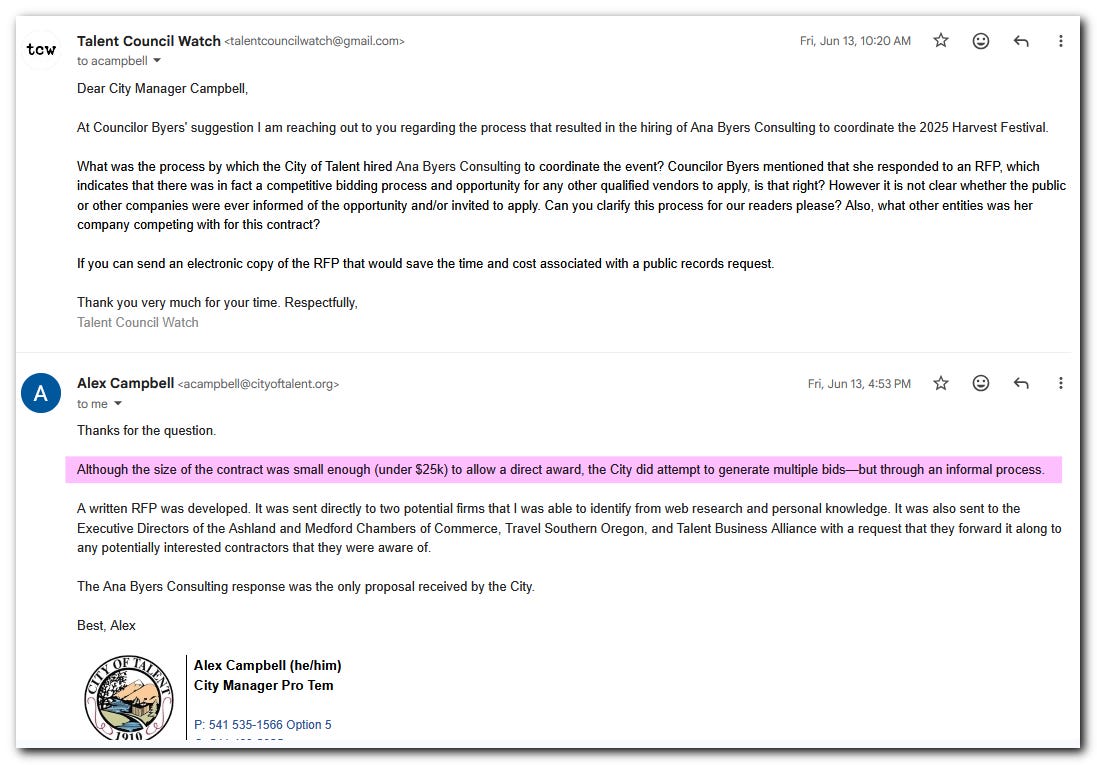
In other words, “We’re not required to allow anyone to apply for this other than exactly who we know we’ll give it to, but we should go through the motions to make it look like it was nominally competitive just so no one can say it wasn’t.” - Not a direct quote.
Let’s refer to this process as Predetermined Procurement. It’s essentially a reputational management exercise and it is 100% guaranteed to come up again in the TCW Report. And again, and again.
I suspect Campbell relies on this tactic because it creates a convenient paper trail for when closed door dealings with the City are questioned down the road. It’s a technical defense masquerading as transparency and open competition. In this particular scenario, the City gets to claim it invited competition even when it didn’t have to! so that concerns around insider contracting and perceived conflicts of interest can be dismissed, and TBA gets the funding and influence it’s been building toward all along with a massive advantage over any possible competition that might submit a Letter of Interest. Win-Win!
The 6-Minute Vote
That same October 1st meeting is also revealing because it shows us what the distorted decision-making environment looks like in practice. When the same person presides over Council, chairs TURA, appoints advisory bodies and committees, helps design the project itself, and leads the organization positioned to benefit, the real deliberations are obviously happening long before any public meeting begins. By the time the vote occurs sometimes there’s nothing left to discuss. Sometimes they give up on even pretending.
At the October 1st, 2025 Council meeting (video here, discussion starts at 1:29) City Council agrees to release the proposed Request for Interest (RFI) that invites brief responses from nonprofit applicants to describe their vision for TBA’s already very well-envisioned Hub. There were a few comments about how great it is that they’re being so transparent with their pseudo procurement process and then they passed a motion to open up the competition to other Lead Operators, instead of just straight up handing the contract to TBA.
Miraculously, the entire discussion and vote on whether to open the Lead Operator role to other nonprofits, a major shift after months of positioning TBA as the presumed, obvious, only operator, takes less than 6 minutes.
If ever there were a flashing neon sign that Pre-Meeting Deliberations happen, this was that sign. Are we really supposed to believe this idea was introduced for the very first time in this meeting, as Open Meetings Law intends? (And is what decision transparency actually means). And that a council which has spent most of the last year implicitly treating TBA as the inevitable Hub Operator would suddenly entertain an open procurement process in a Council meeting without a single question, concern, or hesitation?
Imagine how long this conversation would have gone on if it were an actual deliberation! The Mayor would have meticulously walked us through every possible scenario in which someone other than TBA might be selected to run her program and what the problems with that would be. Councilor Ponomareff, the Mayor’s most loyal wingperson, would have gone on too long with her steady stream of TBA praise and a couple of digs at unnamed enemies not in the room. Imagine the actual probing, the doubts, the clarifications, the ridiculous questions, and the sheer quantity of “uhs” that would have filled up a genuine discussion about this agenda item.
Based on historical data, we estimate a true Talent Council deliberation on this topic would have taken at least 6.5 hours and the vote would have ultimately been postponed until staff could conduct more research about something.
Instead: 6 minutes. No questions. No counter arguments. No repeating themselves. Just a quick and clean unanimous vote.
In fact, it seems like at least a few members of this group had to have talked about this at length before this meeting because they also had obviously already come up with the idea to take advantage of the pretend Lead Operator procurement in order to recruit some groups for TBA to subcontract out to, saving TBA an inevitable step down the road.
Again, something that would have normally been painfully long discussion instead got just a couple of quick affirmations.
1:30:09 PONOMAREFF: I think there’s clearly a candidate that you know of, an organization that has been championing this from the start, but I also think that opening it up a little bit helps spread the idea and it also might identify other organizations that could contribute in some way in the future. Perhaps partnering in kind of a modular supportive role of that as well. So I see no harm in this and I think it’ll show a lot of transparency and I think it’s a good idea.
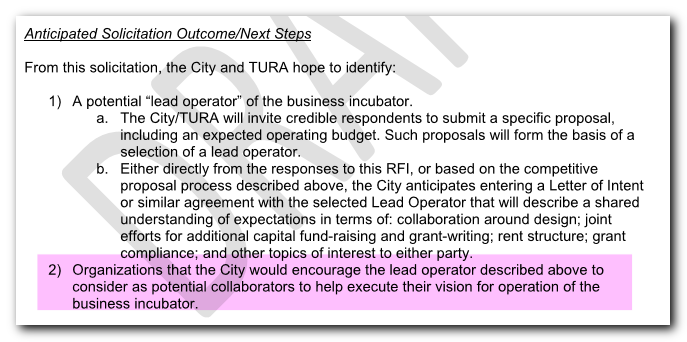
Remember, this was supposed to have been the first time the group was ever meeting on the question of procuring a Lead Operator of the Gateway Hub. It’s a significant change from the path they had been on - they hadn’t up to this point even agreed that there was going to be an actual “selection process” - yet it only takes 6 minutes for everyone to agree on this new strategy?
Whether or not this can be proven or if it technically constitutes pre-meeting deliberation under Oregon law fully misses the point. The speed and unanimity of what should have been a controversial vote reveal quite clearly that the outcome was already a settled matter. Public process in this case is functioning as confirmation, not consideration, and this is certainly not the first time we’ve seen it. The appearance of open deliberation seems to have replaced the practice of it, at least when it comes to the TBA.
Can TBA really run this thing?
Even setting aside all the structural advantages and process concerns, there is a more basic, more uncomfortable question that has gone largely undiscussed since the incubator was first presented.
Is the Talent Business Alliance actually qualified to run the Gateway Hub?
As described in TBA materials, the Hub sounds like a regulated facility, a retail operation, a workforce development program, and a business incubator all at once.
We did some research and found that what the proposed Incubator Hub requires would include the following:
Operating a licensed shared commercial kitchen
Managing food safety and regulatory compliance
Running a staffed retail marketplace
Operating a physical campus day-to-day
Administering multiple revenue streams
Delivering structured business incubation and mentorship
Providing workforce certifications and training
Managing youth programming and the liability associated with that
Handling complex finances, contracts, and reporting
Ensuring extensive and strict grant requirements are met*
*Reminder that if certain requirements are not met by the Lead Operator, the City will have to pay back that 1.25 million dollar grant.
Also reminder that TBA still has to raise another 1 million in order to get the appliances and equipment needed for the incubator.
Now let’s look at the activities that TBA is proud to have accomplished in 2025, as per their full page ad in the December 2025 Talent News & Review:
Organized monthly business mixers
Partnered with a marketplace planner to put on 4 local vendor markets
Supported a quarterly Art Walk
Held workshops about small business
Provided technical support and marketing assistance to small businesses
Managed the RARE student who completed the tourism Strategic Plan
Held talks about art and culture
Presented the Gateway Hub incubator idea to the community
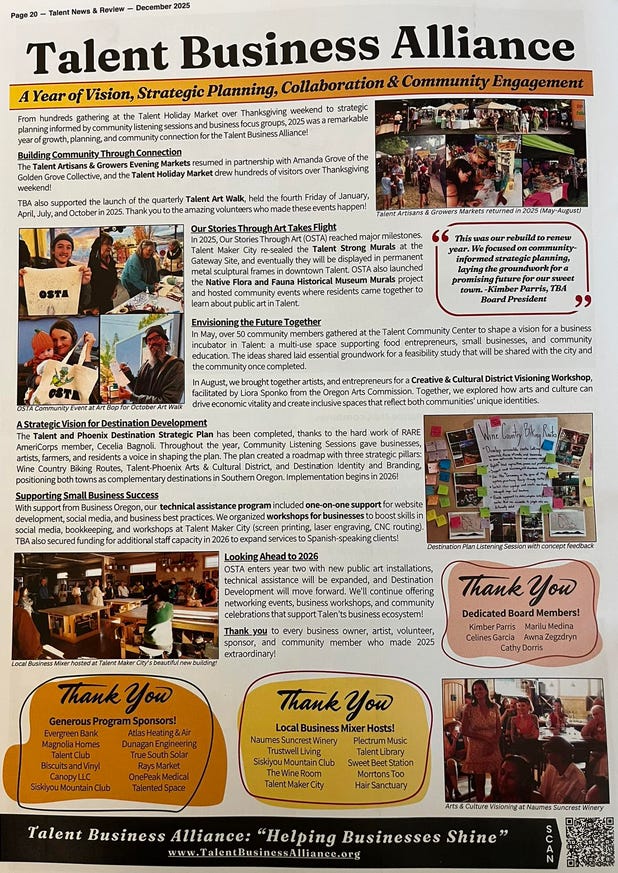
TBA’s work to date has been event-based, advisory, and promotional. The skills required to put on mixers and markets are not the same skills required to operate a licensed commercial kitchen, retail space, and workforce training program. That is complex operations management.
If the Gateway Hub is going to absorb millions of dollars and is supposed to have a major role in Talent’s economic future, the organization entrusted with it should be evaluated on its capacity, experience, and track record, in addition to its vision for and place in the community.
Why are they not talking about this? Is it because the Director of TBA is facilitating every single public meeting that occurs on the topic and could get uncomfortably combative if anyone were to raise a question about TBA’s qualifications in her presence?
There are power dynamics at play here! Capacity should be something an organization demonstrates before they are entrusted with a public project of this cost and magnitude, not something they promise to build afterward, and that expectation shouldn’t be compromised because of power dynamics.
None of this is to say that TBA is bound to fail. No one is claiming those folks don’t work hard! They could very well acquire at least some of the skills and skilled people needed to operate this Hub by the time it actually opens up in a few years from now. But wow, what an incredibly risky financial move for the City to take at a time when this kind of money is hard to come by for so many other vital municipal projects. Feels like putting a literal ton of eggs into one shaky untested basket.
Perhaps the imminent Feasibility Study results will disagree with that assessment though. I look forward to reading that and will post it in the comments to this post whenever it is made available.
Here’s a question I want to end this with: If a local nonprofit applicant with the same track record and experience level was being led by anyone other than the Mayor of Talent, do you think it would be a strong candidate for the Lead Operator role of a food business incubator? And if not, is that a problem?
Why This Matters
Okay okay let’s wrap this thing up so I can push the publish button before the Gateway Open House actually starts.
What Councilor Medina was pointing out in her final comment at that November 5th TURA meeting was that people are confused about TBA staff’s involvement in Gateway project decision-making given the extensive overlap between TBA and Council/TURA, among other things. There were and continue to be deep concerns in the community about the conflicts of interest inherent in this relationship that are being completely ignored by the Mayor and her Council.
And the City’s response to the calls for more transparency on the Gateway does not answer the questions people actually have about the decisions being made.
The Gateway Open House will allow the public to ask questions about this project and recent progress on it in a format that is not typically made available to us. It’s a great opportunity to make your concerns or support clear and to ask your questions, even if you have to keep it under 3 minutes.
Here are some questions I have for them, if anyone wants to represent:
How would you respond to residents who feel like the Mayor also being TBA Director gives TBA an ethically questionable role in determining the outcome of City decisions about your Gateway projects?
How will you ensure that businesses aligned with the TBA do not receive preferential treatment from the City of Talent?
How does the Mayor justify participating in deliberations and votes about the Gateway that benefit the nonprofit she runs and is employed by, even though they may not technically be considered conflicts of interest violations by OGEC?
What do you think it does to a vote when the Mayor is also the employer of Council members and whose organization stands to benefit from that decision?
City Council/TURA seem inclined to give TBA what it requests from them regardless of the merit or value of the request. Can you explain why this is and if it could have anything to do with the power dynamic of the Director of TBA being the Chair of both groups?
Maybe you’re thinking ok fine, there’s overlap. So what? As long as it’s all for the good of Talent what does all this even matter?
Because government entities are bound by laws that guarantee transparency, fairness, and public oversight. Private businesses and nonprofits are not. When the boundaries between the two are so deeply blurred we’re left not knowing where the line is and when it’s been crossed and not sure who to hold accountable. This raises serious questions when consequential decisions are being made about Talent’s future - are they being made by our government, or by a private organization with specific interests acting in its place?
Public power and nonprofit interests are supposed to stay on opposite sides of the line. That line exists to protect taxpayers, ensure fairness, and keep decisions about public resources in public hands. But over the past few years, the Talent Business Alliance and the City of Talent have become increasingly hard to tell apart. That isn’t an abstract governance concern, it creates real, practical problems for residents, small businesses, and the City itself.
Here are just a few not-so-great outcomes:
Public money becomes harder to track and harder to challenge. When City projects, grants, and priorities are routed through a nonprofit, it’s difficult for residents to tell who made a decision, under what authority, and on which budget. That makes public oversight on spending harder and thwarts accountability when something goes wrong.
Other businesses and nonprofits stop bothering to participate. When one organization consistently has early access, inside knowledge, and City backing, other potential contributors or competitors reasonably conclude the process is not worth their time. That’s fewer ideas, fewer local voices, less competition, and missed opportunities for Talent businesses that don’t have political access. We’re already seeing this happen quite a bit.
City staff time gets quietly redirected. When a Mayor-led nonprofit is treated as a de facto City partner, staff effort tends to flow in that direction. That leaves less time and capacity for other City needs residents care about, like infrastructure, housing, and basic services.
If a project run through a TBA–City partnership fails to meet requirements, under-performs, or stalls, the City is on the hook. That risk is not theoretical. It falls directly on taxpayers.
Decisions get made earlier and farther from the public. As long as ideas are developed informally and decided on before public meetings, public input will always be reactive instead of impactful and meaningful. We will keep having to respond to plans that already feel decided on, and that makes civic participation feel discouraging and pointless.
The City is becoming dependent on one organization. When a single nonprofit like TBA is positioned as the solution provider for multiple economic and cultural goals, the City loses flexibility. That kind of dependency is risky for a small city with limited resources. What happens when their funding goes away and the City no longer functions the way it did before it outsourced its services to the nonprofit?
Sorry to end on such a bummer note, but I fear that none of these problems are likely to resolve themselves. The OGEC isn’t touching this stuff. These things are built into how Talent is currently governed and who holds power at the moment. If the people of Talent want a clearer separation between public authority and private interests, the only durable way to achieve that is through the ballot envelope. Structural change will not come from complaints alone. It comes from choosing different leadership. The next real opportunity to do that is the November 2026 election. Will the Mayor run again, or will she lean into her new career as an incubationist and try to put her #2 in the driver's seat?
Until then, please share your thoughts in the comments. You can be a ‘coward’ like me and do it anonymously so that you don’t get cancelled by the Pitchfork Caucus. Or you can write your own rebuttal to this post and if it’s good we might publish it as a guest author, anonymous or otherwise. Or tell me if you hated this or if I got something wrong or if I missed something big or whatever. But just don’t try to dox TCW anymore, please. I’m a regular person in this community who happens to have a lot of thoughts about Talent leadership and an annoying, time-consuming urge to write about them here. This is not the scandal. I am not the thing you should be worried about.
Buddy
talentcouncilwatch@gmail.com